


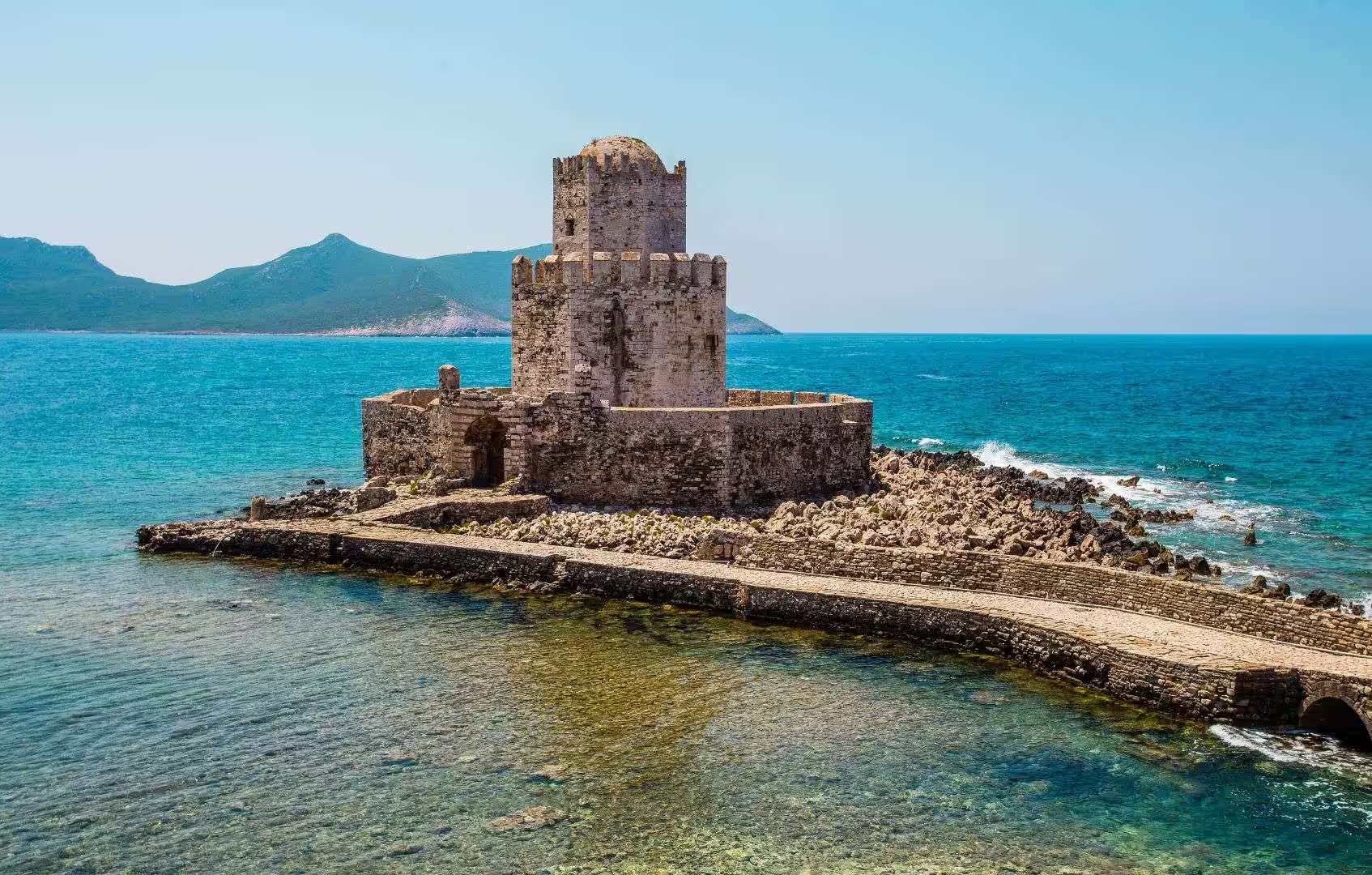
Drive to Methoni Castle and you arrive at the back of it. You cross a stone bridge over a dry moat, pass through the land gate, and walk into a vast, sun-bleached space of foundations and cisterns. It is remarkable. It is also, historically speaking, the tradesmen’s entrance.
The people these walls were built to impress — and to deter — never came by road. They came by sea, and what they saw was a wall of stone rising straight out of the water, with an octagonal tower planted on a rock in front of it.
That view still exists. It just requires a boat.
Why Venice Cared So Much About Two Small Towns
In the early 13th century, after the partition of the Byzantine Empire that followed the Fourth Crusade, the Republic of Venice took control of two harbours at the southwestern tip of the Peloponnese: Koroni and Methoni. The arrangement was confirmed by the Treaty of Sapienza in 1209, and Venice held both for very nearly three centuries.
They were not agricultural prizes. They were navigational ones.
Every Venetian galley, pilgrim ship and merchant convoy running between the Adriatic and the eastern Mediterranean had to round this cape. Ships needed water, shelter and repair before the open crossing; and Venice needed to know who was passing. The two fortresses controlled that gate together, which is why the Venetians referred to them as “oculi capitales communis” — the chief eyes of the Republic.
Both fell to the Ottomans in 1500, were briefly retaken by Venice under Francesco Morosini in the 1680s, and returned to Ottoman hands in 1715. Each layer left something behind, and from the water you can read them in sequence: Byzantine foundations, Venetian curtain walls and bastions, Ottoman additions on top.
Koroni: Anchoring Under a Living Castle
Koroni sits on the western shore of the Messinian Gulf, a direct crossing of about an hour from Kalamata Marina aboard a fast motor yacht. The town rises in an amphitheatre around its harbour, whitewashed houses stacked up the slope, with the fortress filling the entire headland above.
What makes Koroni unusual is that its castle never emptied. Inside the walls there are houses, gardens, chapels and the working Timiou Prodromou monastery, whose nuns still tend the terraces. It is a fortress that turned into a neighbourhood.
From the sea, the approach is theatrical. The bastions grow out of the rock at the tip of the headland, and the yacht can anchor close in, beneath walls that have not changed shape in five hundred years. The water at the base is clear enough to snorkel, and our crew can tender you into the harbour to walk up through the town, through the castle gate and out onto the ramparts.
South of the castle the coast opens into Zaga and Memi — two of the longest golden beaches in the Peloponnese, and nesting grounds for the loggerhead sea turtle (Caretta caretta). Anchored just offshore, you have the swimming without the sand-scramble, the crowds or the midday heat, and you keep the castle in frame the whole time.
Methoni: The Fortress That Walks Into the Sea
Round Cape Akritas and head west and the landscape changes character. Methoni faces the Ionian, and its fortress is built on a low promontory that runs out into the water until it simply runs out of land.
Methoni Castle is among the largest and best-preserved Venetian fortifications in Greece. The sea walls run for hundreds of metres, punctuated by bastions built for artillery. And at the far southern tip, connected by a narrow causeway, stands the Bourtzi — an octagonal tower on its own islet, added by the Ottomans after 1500 as the final strongpoint of the complex.
The Bourtzi is the single most photographed structure on this coast, and almost every photograph is taken from the land, looking out. From a yacht you get the reverse: the tower in the foreground, the fortress behind it, and the whole silhouette laid out the way an approaching captain would have seen it in 1450.
The waters here connect straight to Sapientza and Agia Marina, part of the Oinousses group, where the water clarity is among the best in Messinia. A half-day cruise from Methoni takes in Sapientza; a full day adds Agia Marina and Shiza.
The One-Day Route: Both Castles, One Yacht
The two fortresses are about 16 nautical miles apart by sea, around Cape Akritas. That is comfortably inside a full-day private cruise — and it is a very different day from the road version.
By road: Kalamata to Koroni is close to an hour on winding coastal roads. Koroni to Methoni is another hour inland. Parking in both towns is difficult in July and August, and you arrive at each castle from behind, on foot, in the heat.
By sea: Kalamata to Koroni is about an hour of cruising. You anchor beneath the walls, swim at Zaga, tender ashore for a coffee in the harbour, then continue around the cape to Methoni with lunch served on board along the way. You arrive at the Bourtzi from the water, in the afternoon light, with the swim platform down.
What to Bring for a Castle Day
- Shoes you can walk in. The castle at Koroni is a climb, and the ground inside Methoni is uneven stone.
- A hat and high-factor sun cream. There is almost no shade inside either fortress.
- A light cover-up. The Timiou Prodromou monastery at Koroni is an active religious community, so shoulders and knees covered is the courteous choice.
- A camera with a wide lens. The sea-facing walls do not fit into a phone frame from close range.
- Swimwear on under everything. The best water of the day is usually the first anchorage.
Everything else — towels, snorkelling equipment, shade, cold drinks, bathrooms and showers — is already on board.
Frequently Asked Questions
How can I visit the castles of Koroni and Methoni?
Both castles are open to visitors and can be reached by road or by sea. By road, Koroni is about an hour from Kalamata and Methoni a further hour from Koroni. By sea, a full-day private cruise from Kalamata Marina reaches Koroni in roughly an hour, anchors beneath the castle, then continues around Cape Akritas to Methoni — covering both fortresses in a single day, with swimming and lunch on board in between.
Can you see Methoni Castle and the Bourtzi from a boat?
Yes, and it is the view the fortress was designed for. Methoni’s longest and most heavily fortified walls face the sea, and the octagonal Bourtzi tower stands on an islet at the southern tip of the promontory. From a yacht you see the tower, the sea walls and the full silhouette of the castle in one frame, exactly as an approaching ship would have.
How long does it take to sail from Kalamata to Koroni?
Approximately one hour aboard our motor yachts, crossing the Messinian Gulf directly. The same journey by road takes close to an hour on winding coastal roads, followed by the search for parking in the town.
Is Koroni Castle still inhabited?
Yes. Unlike most Greek castles, Koroni’s fortress was never abandoned. Within its walls there are houses, gardens, chapels and the working Timiou Prodromou monastery. Visitors walk through what is effectively a hillside village enclosed by 13th-century Venetian fortifications.
Can we combine the castles with swimming and lunch?
Yes — that is how we build the itinerary. The anchorage beneath Koroni Castle and the beaches of Zaga and Memi are ideal for swimming, and Sapientza and Agia Marina add some of the clearest water in Messinia on the Methoni side. Lunch is served on board, with the option of a private chef, a bartender and a customised menu.
Ready to Sail the Venetian Coastline?
Koroni and Methoni have been guarding this stretch of sea for eight hundred years. A full-day private cruise puts you on the right side of the walls.
Plan your castles cruise from Kalamata
Full-day charters are in highest demand from June through September — we recommend enquiring at least three weeks in advance.